
Taming Aversion
How Institutions Utilize Aversion to Foment Hatred and Distraction

Aversion and Attraction: A Lab Exercise
Imagine sitting with a dating app open. A stack of faces scrolls past: strangers, each packaged with a few photos and words. Within seconds, your mind sorts them into three bins: “like,” “dislike,” “disregard.” These results are tied to the function of predictive algorithms working away in our wet and wrinkled little brains. This quick sorting process allows us to answer the question: How likely is this person going to align with what I believe would be in the best interest of my social and romantic future?
Pause and reflect:
How quickly do you decide to swipe left or right, to turn away or linger?
What information are you really using to make that decision?
How much of it comes from the photo or profile itself, and how much comes from your own conditioned red lines and preferences?
This sorting process works the same way in daily physical life: walking through a café, entering a workplace mixer, or standing in line at the grocery store. Our evolutionary wiring allows us to make quick judgments based on very thin evidence.
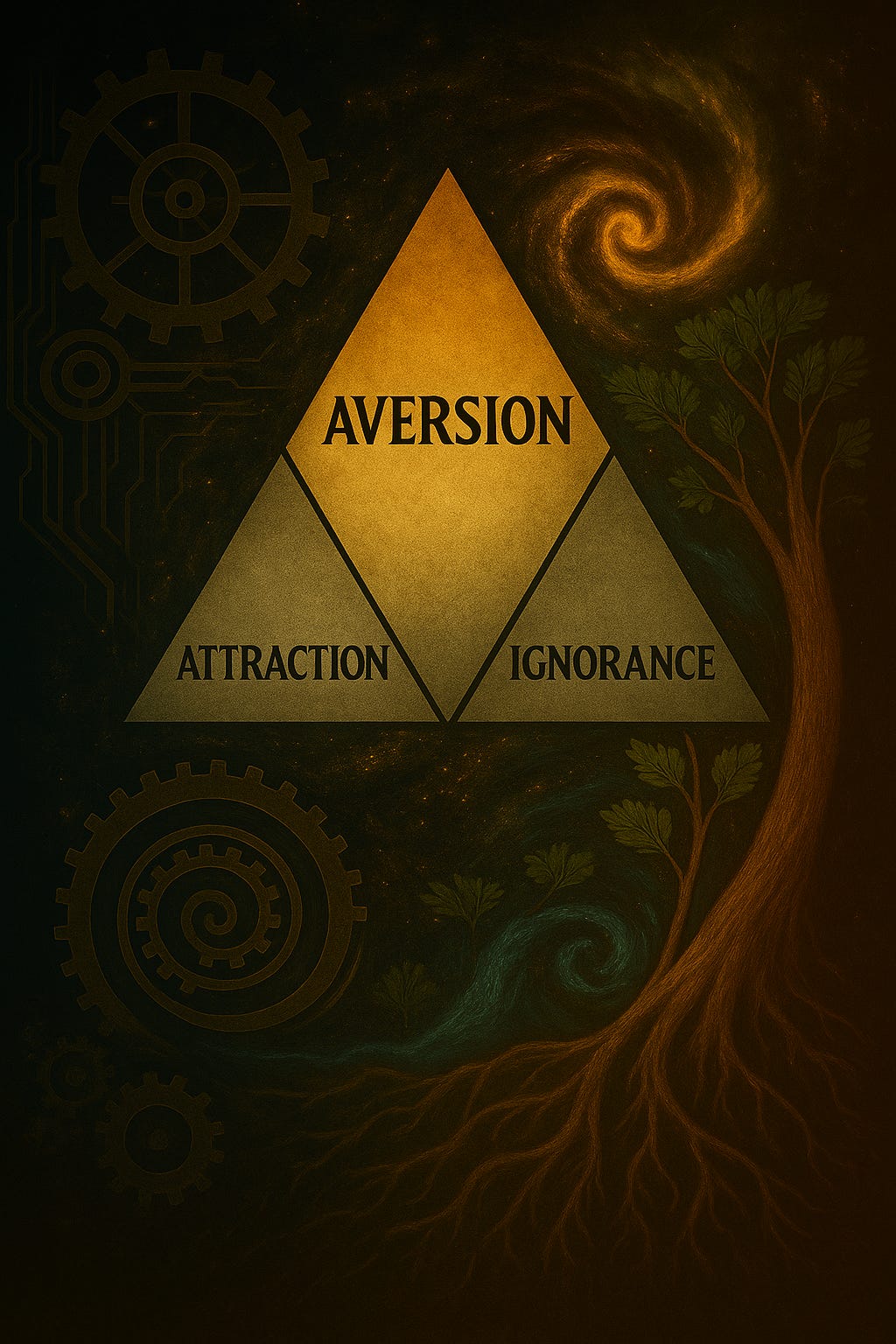
This experiment reveals the baseline mechanics of a fundamental cognitive process for sorting stimuli into three general categories. In Buddhism, these are framed as attraction, aversion, and ignorance. While serving important purposes for our happiness and survival these three responses also represent a vulnerability with the potential to lead us into mental states of distraction and suffering. This is why they are framed as “three poisons” in Buddhist thought and teachings.
In the previous essay Taming Desire, we explored how institutions exploit attraction by directing and provoking desire. Now we turn to its darker twin: aversion. While our ability to make these decisions is valuable, in their extremes, they become toxic to the individual and the communities within which we all abide. Just as desire can be distorted into obsession and greed, aversion can be manipulated into hatred and anger.
What Aversion Looks Like in Modern Life
Aversion is everywhere. Political events, media scandals, culture wars: each week delivers a case study in how anger is cultivated to serve established interests of power. Institutional and political force is applied to silence public media figures who are deemed unfriendly to the tyrants. Aversion, in its most extreme and pathological form, can also provoke the psychologically fragile to murder the human targets of their hatred and anger.
The demonization of “others,” the degradation mindset whereby some groups are situated on the periphery of who a given in-group defines as fully human, “saved”, or worthy of respect, happens in every conceivable direction. The extremes on the right cast caricatures of extremes on the left as barely human, deserving of harassment and persecution. The extremes on the left cast caricatures of extremes on the right as fascists equally worthy of harassment and torment.
In every case human individuals are provoked through the news they consume, the voices they entertain, the echo chambers they call “home.”. The inflammation of hate and anger is predictable, in fact it is planned and orchestrated by the political forces that benefit most from a population that is hopelessly distracted by distrust and factionalism. It is a technology that has been refined throughout the past couple of centuries but is now coming into its fullness thanks to AI enhanced tools for honing such predictions and for crafting such incantations.
This is no accident. Political operatives, corporations, and media outlets engineer outrage. Modern tools sharpen the effect:
Algorithms predict what will inflame a given demographic to anger.
Micro-targeting ensures the message reaches precisely the right audience.
AI-enhanced content escalates intensity with uncanny precision.
Aversion, once a reflex, is now a target of the infrastructures of control: a system built to capture attention and convert anger into profit and distraction.
When a Cognitive Adaptation Becomes a Dead End
Aversion once served us well. For our ancestors, quick judgments—friend or foe, safe or dangerous—had genuine survival consequences. Conserving energy by swiftly labeling “adopt” or “avoid” often kept them alive.
But in today’s world, that advantage has become a liability. Consider food cravings: salt, sugar, and fat helped our ancestors survive scarcity. In an age of abundance, those same cravings cause obesity, diabetes, and heart disease. In our modern context these evolved preferences and cognitive predispositions can become the causes of disease and suffering.
Aversion now works in the same destructive manner:
What once helped us to survive in hostile environments now results in societal dis-ease.
What once conserved energy now fuels complex networks of mistrust.
What once guarded communities from harm now provokes and justifies violence against other human beings.
The costs are significant and distributed across societies:
Personal: widespread and increasing levels of anxiety, paranoia, emotional exhaustion, all forms of suffering.
Social: fragmentation of trust, erosion of shared identity undermine efforts for collective action required to address real world problems.
Political: a public too divided and distracted to hold leaders accountable creates the opening within which tyrants may flourish.
In an interdependent world, the logic of hate collapses. Hatred provides no path forward and no future anybody would wish upon our descendants. Every person, every community, deserves the happiness they seek. Mutual aid and solidarity are the only ways to a sustainable future. Aversion, left unchecked, blinds us to that truth.
What Skillful Aversion Looks Like
It’s worth emphasizing that aversion itself is not the enemy. It is a signal—an alarm that something feels unjust, unsafe, or harmful. The question is whether we let it harden into hatred or refine it into wisdom.
Practical steps to reclaim aversion as a teacher:
Notice the spark. When anger arises, simply name it: “this is aversion” or “this is anger.” Even a brief pause reduces the negative charge around the experience.
Distinguish harm from hate. Recognize injustice without dehumanizing the person behind it. Remind yourself that the person provoking your anger is seeking happiness and managing their suffering in ways that are beyond your understanding or control.
Practice compassion. Recognize that those afflicted with anger cannot be happy. There are Buddhist meditation practices that can help cultivate compassion: metta (loving-kindness), tonglen (breathing in suffering, breathing out relief), lojong (slogans like “hatred does not cease by hatred, but by non-hatred alone”). Other wisdom traditions teach similar grounding practices.
Redirect energy into clarity. Anger wants to act. Use its fire to illuminate, protect, or create—through peaceful protest, art, ritual, or bridge-building.
This isn’t passivity. It’s a refusal to expose our human vulnerability to institutions that would manipulate our aversion to be used as a weapon to foment distraction, hatred, and violence.
Resistance and Institutional Change
Understanding that aversion has been built into the very infrastructure of politics and media, personal and systemic responses are needed to ground the charge, to resist manipulation.
Personal strategies:
Reclaim your attention. Step away from doomscrolling and bait. Starve the outrage machine. Do not allow the hateful to control your own peace of mind.
Model non-demonizing speech. Humanize others in conversation, even opponents.
Build resilience at home. Redirect energy into budgeting wisely, strengthening family safety nets, and nurturing presence with loved ones. Model compassion and teach tolerance to our children.
Systemic strategies:
Demand better platforms. Support media that values mutual respect over division.
Insist on healthier political norms. Reward leaders who avoid demonization and speak with integrity. Deny tyrants the attention they need to survive.
Strengthen civic education. Teach emotional literacy, meditation, propaganda recognition, and skills for managing anger.
Each act—personal or collective—weakens the grip of institutionalized hatred.
Conclusion
Aversion is not just a private poison. It has become a public utility, deliberately engineered into algorithms, news cycles, and political rhetoric. When hatred becomes infrastructure, every community pays the cost.
The antidote begins with awareness. Notice when aversion rises, discern its true object, and resist its transformation into hate. Scaled up, this practice becomes revolutionary. A society that refuses to be baited into anger is far harder to divide, exploit, or control.
The choice is before us: let our aversion be weaponized, or tame it into clarity, positive action, and compassion. The first path feeds the Engines of Samsara. The second leads us into a sustainable future of mutual care and respect for all beings.